
Hair Loss | Postpartum Hair Loss Due to Reduced Starch and Meat Consumption: Traditional Chinese Medicine Doctor Reveals 4 Hair-Reversing Techniques (with Dietary Therapy)
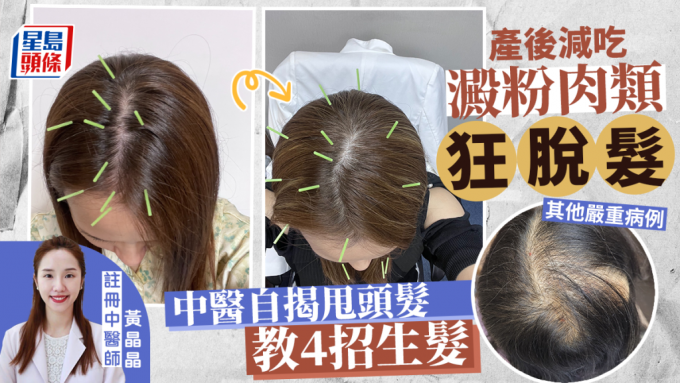
A traditional Chinese medicine practitioner revealed that she experienced severe hair loss after reducing her intake of starchy meats postpartum, and she shared four methods to help her regain her hair.
Hair loss is a common problem and a concern for many new mothers, even Chinese medicine practitioners encounter this challenge. Registered Chinese medicine practitioner Wong Ching-ching shared her experience of postpartum hair loss with Sing Tao Daily, saying that two months postpartum, she suddenly noticed increased hair loss when washing and drying her hair, which startled her. She also shared several methods to improve postpartum hair loss, encouraging others going through the same experience.
Causes of postpartum hair loss
Registered Traditional Chinese Medicine practitioner Huang Jingjing points out that there are three causes of postpartum hair loss. Click the image for details:

Dr. Huang shared the causes of her postpartum hair loss.
Doctor's postpartum hair loss symptoms
Dr. Wong Ching-Ching, who is registered, revealed that she experienced the following symptoms when she was losing hair: her hairline and crown were more noticeable; her scalp was oily and itchy; and the hair loss was mostly in a single, uniform strand with small white dots at the roots.
She explained that the white dots are the keratin structure of the hair, which is the natural shedding of hair in the resting phase. Generally, the resting phase hair covers less than one-tenth of all hair.
Metabolic process VS hair loss crisis
However, we lose hair every day. How can we tell if it's a normal metabolic process or a hair loss crisis? Dr. Huang Jingjing explains that if the hair that falls out is thinner and shorter than normal hair, it means that the hair did not grow healthily in the hair follicle and entered the resting phase before falling out. This is an unusual hair loss situation that needs attention.
She continued, pointing out that hair loss in women often occurs after childbirth and around the time of menopause, which is related to changes in hormone levels in the body. As for the hair from the forehead to the top of the head becoming thinner first, this is also the most prominent symptom of hair loss in women.
Methods to promote healthy hair follicles
According to Dr. Huang Jingjing, a registered physician, postpartum hair loss is often caused by insufficient Qi and blood, leading to thinning and easy shedding of hair due to lack of nourishment. Secondly, postpartum mothers are prone to emotional fluctuations, resulting in stagnation of liver Qi. Liver stagnation obstructs the flow of Qi and blood, causing hair to lack nourishment as well. The liver meridian also runs through the top of the head. From a Traditional Chinese Medicine perspective, frequent outbursts of temper can lead to hyperactivity of liver Yang, causing Yang Qi to stagnate on the scalp, resulting in increased scalp oil and making hair more prone to falling out.
Dr. Huang Jingjing pointed out that in order to control postpartum hair loss, it is essential to take care of the body in a timely manner after childbirth, and to eat some foods that nourish blood and qi and drink soups.
She recommends 8 ingredients that nourish blood and qi. Click on the image for details:
In addition, Dr. Huang Jingjing also recommends that people with hair loss eat more iron-rich foods. Click on the image for details:
Postpartum depression can lead to stress-related hair loss, and postpartum mood swings and depression are common among most postpartum women. Symptoms include insomnia, tearfulness, irritability, and frequent feelings of lethargy and fatigue. Dr. Huang suggests seeking understanding and support from family and friends. The doctor also notes that when symptoms persist, traditional Chinese medicine treatments such as acupuncture and herbal medicine can be particularly helpful, improving mood and sleep quality, thereby controlling hair loss.
3 acupoints to improve postpartum hair loss
Postpartum mothers are still recovering from childbirth, and if they also have to deal with hair loss, it's an added burden. Dr. Huang Jingjing teaches everyone how to press 3 acupoints to help improve postpartum hair loss.
Click the image to see the location of the acupoints:
Are hair loss shampoos or herbal shampoos effective?
Some hair loss sufferers try switching to anti-hair loss shampoos or herbal shampoos in the hope of improving their condition. Dr. Huang Jingjing explained that a drug called minoxidil can slow down hair loss and promote hair growth. Adding it to shampoos may help improve hair loss, but shampoos often have low concentrations of the drug, and after rinsing with water, the drug's effect on the scalp is limited.
While herbal shampoos contain nourishing Chinese herbs, doctors believe that internal use or external application of herbal decoctions is more effective. Some people with sensitive scalps have also reported that certain brands of herbal shampoos do not clean their scalps thoroughly enough. Ideally, you should choose a shampoo that doesn't cause scalp sensitivity, redness, or itching, and leaves your scalp feeling dry and without noticeable oiliness after washing.
Can acupuncture improve postpartum hair loss?
Dr. Huang stated that acupuncture can improve most postpartum hair loss within six months, and she will use needles close to the thickness of hair follicles to focus on stimulating the top of the head and the areas with obvious hair loss at the forehead.
She also pointed out that acupuncture can stimulate increased blood circulation near the hair follicles, activate the follicles, promote healthier hair growth, reduce oil secretion, and improve scalp itching. Therefore, she gets a few acupuncture needles after each shampoo, averaging once every 3 to 4 days, which helps control her scalp itching.
Dietary therapy to improve hair loss
In addition to scalp acupuncture, Dr. Huang Jingjing also drinks black chicken soup once a week, which helps control her hair loss. She says that mothers experiencing postpartum hair loss can also improve their condition through dietary adjustments. She recommends Five Black Chicken Hair Nourishing Soup, which helps replenish qi and blood and nourish and darken hair.
Click on the picture to see the soup recipe details: